
Ancient Africa: Nubia, Kush, Egypt, and Aksum
Students study the Nile corridor as one connected world, including Nubian and Kushite rulers, and Aksum's Red Sea trade, coinage, and early Christian kingdom.
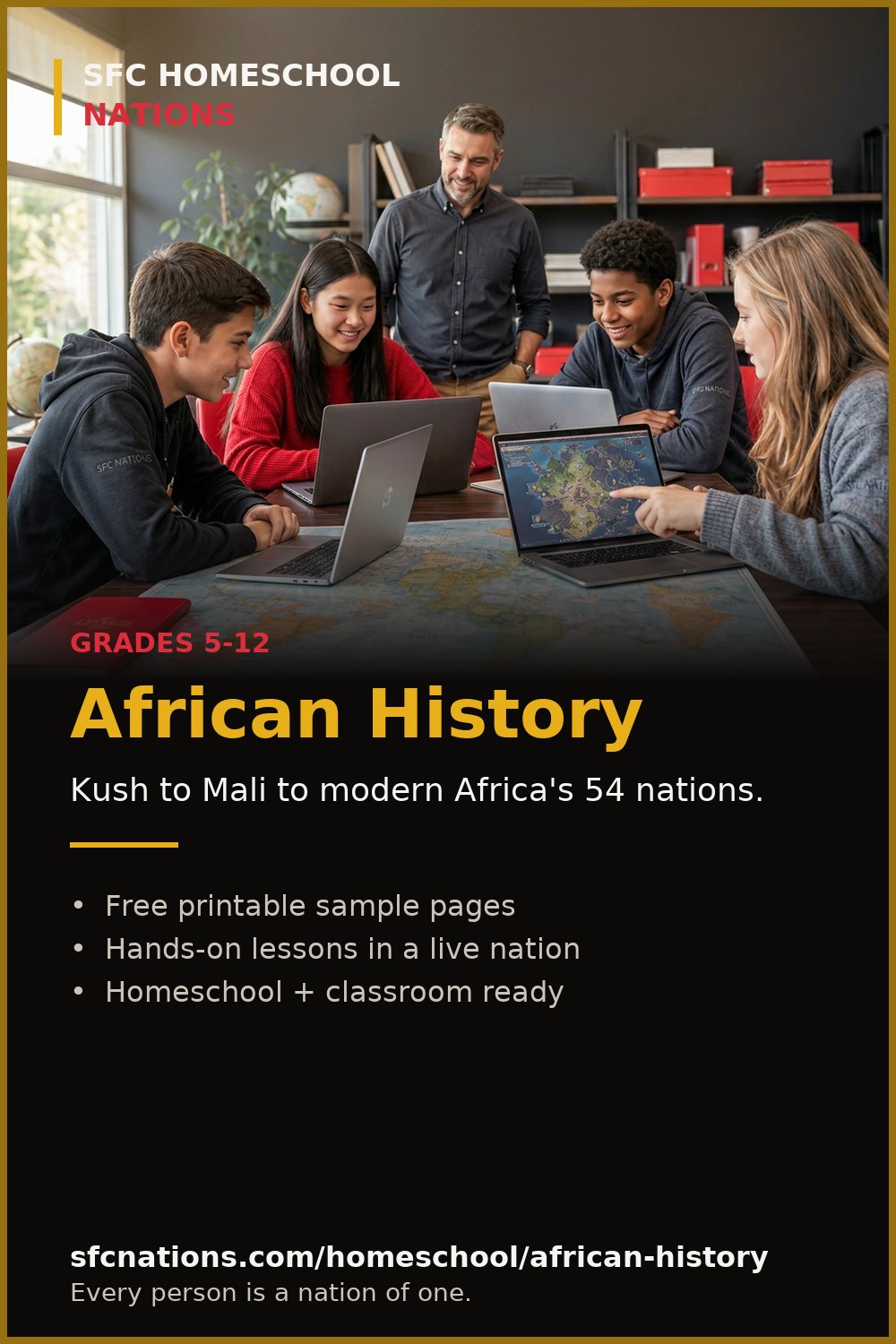

Grades 5-12
Africa's kingdoms, trade routes, and modern nations, taught as a full story.
African history is usually squeezed into two chapters about colonialism. This unit starts thousands of years earlier with Kush, Aksum, Ghana, Mali, Songhai, Great Zimbabwe, and the Swahili coast, follows the trade and scholarship that made those states wealthy, then walks students through colonization, independence, and the 54 nations of Africa today. Inside SFC Nations students can found a nation on real African terrain, choose its resources and government, and feel how geography and trade shape a state's power.
Download the sample PDF (free)3 printable pages · no account needed · see the sample pages first
Share African History
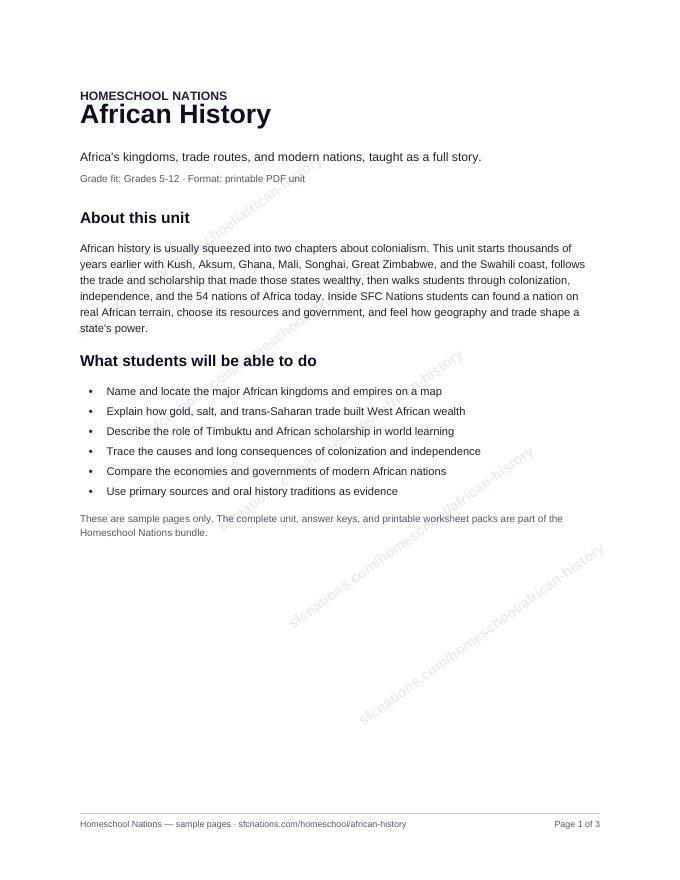
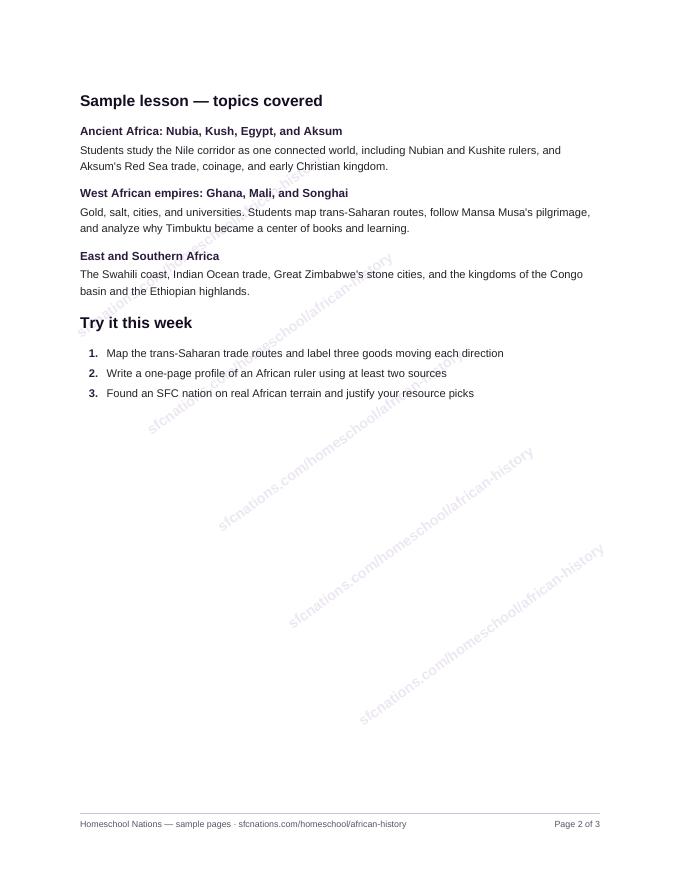
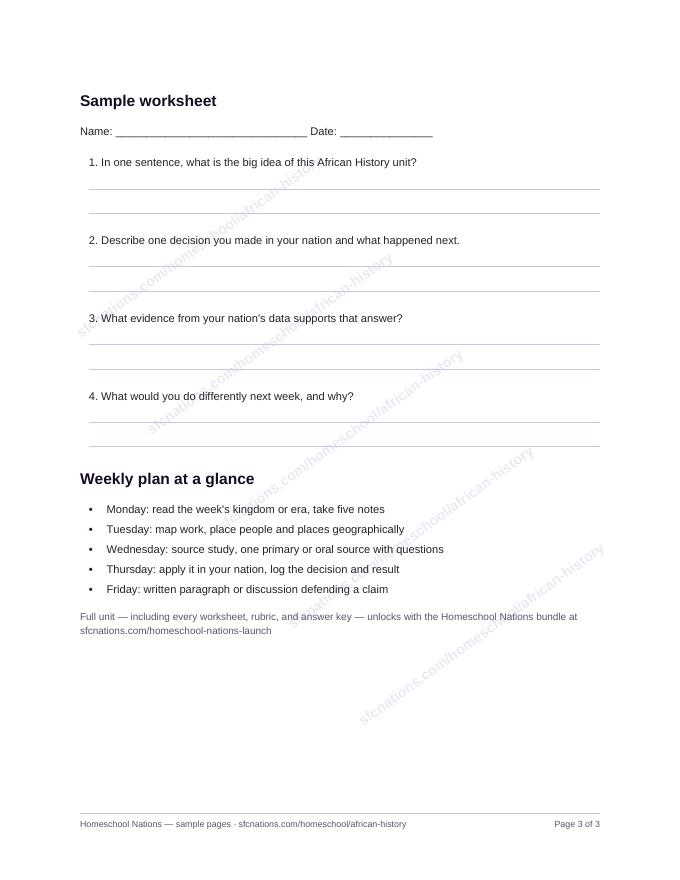
Three printable sample pages from the African History unit: the unit overview and learning goals, a sample lesson, and a student worksheet with the weekly plan. Free to preview, print, and use with your students right now.
The complete unit, every worksheet, rubrics, and answer keys are available now in the Homeschool Nations curriculum packages.
Students study the Nile corridor as one connected world, including Nubian and Kushite rulers, and Aksum's Red Sea trade, coinage, and early Christian kingdom.
Gold, salt, cities, and universities. Students map trans-Saharan routes, follow Mansa Musa's pilgrimage, and analyze why Timbuktu became a center of books and learning.
The Swahili coast, Indian Ocean trade, Great Zimbabwe's stone cities, and the kingdoms of the Congo basin and the Ethiopian highlands.
The Berlin Conference, extraction economies, resistance movements, and the independence wave from Ghana in 1957 onward, plus what borders drawn by outsiders still cost.
Population growth, resources, technology leapfrogging, the African Union, and continental free trade. Students compare real nations to the one they run in-game.
It is an 18-week half-year spine that pairs cleanly with the World History unit for a full year of history credit.
Yes. Most of the unit covers ancient and pre-colonial Africa, because that is where the story actually starts.
Grades 5-12. Younger students read alongside a parent; high schoolers can carry it as a graded credit with the writing assignments.
Yes. Three printable sample pages download free, no account needed.
The complete Homeschool Nations curriculum bundle and standalone digital book are available to purchase and download now.