

Homeschool Nations
Why Choose SFC Nations for Homeschool Curriculum?
Not a list of marketing claims. This is the actual difference in how the learning works, written for parents and teachers who already own a shelf full of curriculum.
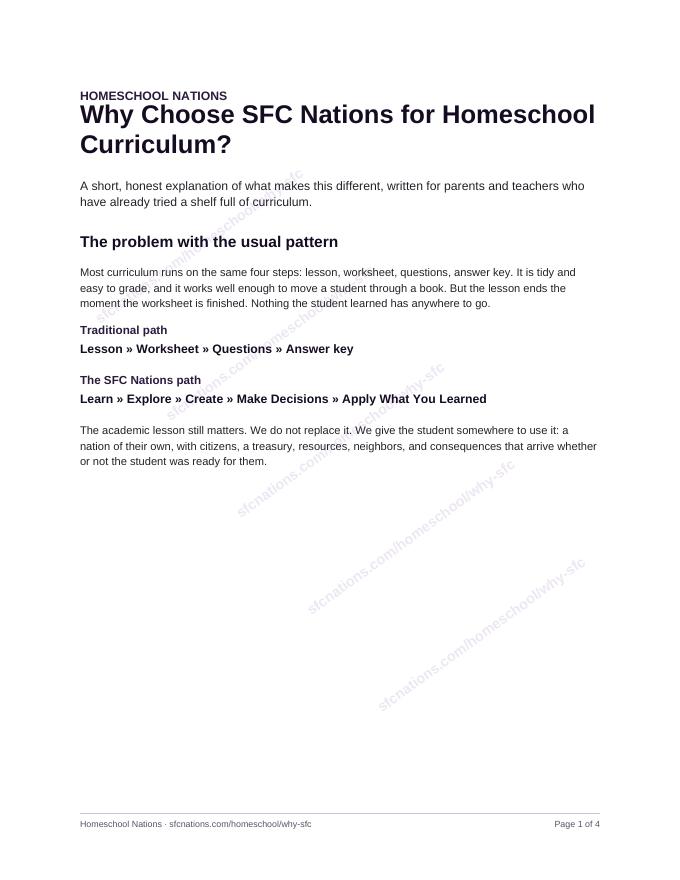
The usual pattern
- 1Lesson
- 2Worksheet
- 3Questions
- 4Answer key
It is tidy and easy to grade. But the lesson ends the moment the worksheet is finished, and nothing the student learned has anywhere to go.
The SFC Nations pattern
- 1Learn
- 2Explore
- 3Create
- 4Make Decisions
- 5Apply What You Learned
The academic lesson still matters and we do not replace it. We give the student somewhere to use it: a nation with citizens, a treasury, neighbors, and consequences.
The learning cycle, stage by stage
Learn
The academic concept comes first, stated plainly. We do not skip the teaching to get to the fun part, and we do not pretend a game replaces a lesson.
Explore
The student pokes at the idea before using it: compares examples, asks where it breaks, and looks for it in their own life and in the real world.
Create
They make something that belongs to them — a government, a budget, a resource plan, a speech, a flag — inside a nation nobody else runs.
Make Decisions
Every option costs something. Raise taxes and lose happiness. Cut the military and invite an attack. The student has to choose and defend the choice.
Apply What You Learned
The decision plays out in data the student generated themselves. They measure the result, admit what went wrong, and adjust next week.
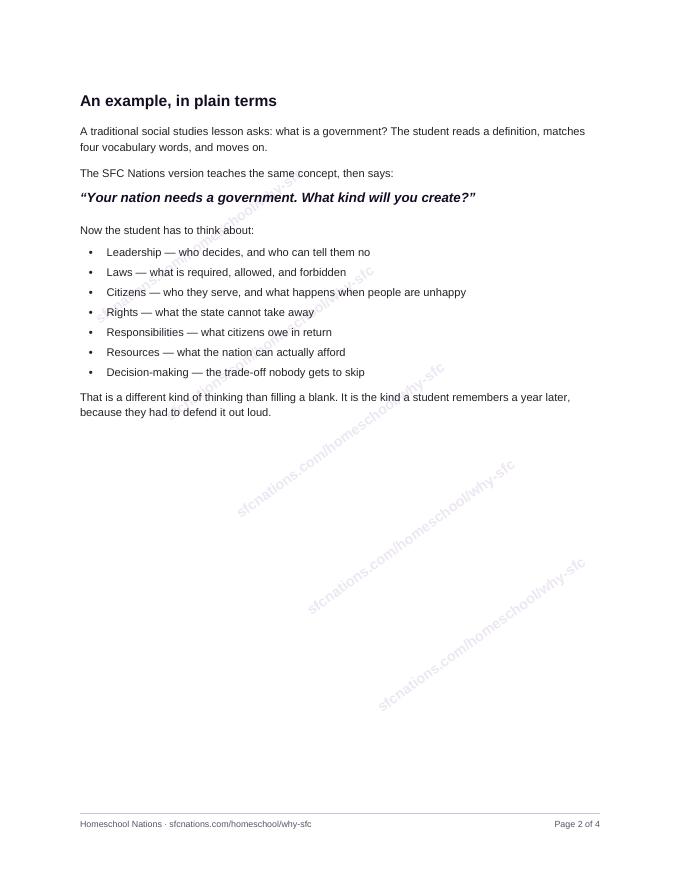
An example, in plain terms
A traditional social studies lesson asks: what is a government? The student reads a definition, matches four vocabulary words, and moves on. The SFC Nations version teaches the same concept, then says:
"Your nation needs a government. What type will you create?"
Now the student has to think about:
- Leadership — who decides, and who can tell them no
- Laws — what is required, allowed, and forbidden
- Citizens — who they serve, and what happens when people are unhappy
- Rights — what the state cannot take away
- Responsibilities — what citizens owe in return
- Resources — what the nation can actually afford
- Decision-making — the trade-off nobody gets to skip
That is a different kind of thinking than filling a blank. It is the kind a student still remembers a year later, because they had to defend it out loud.
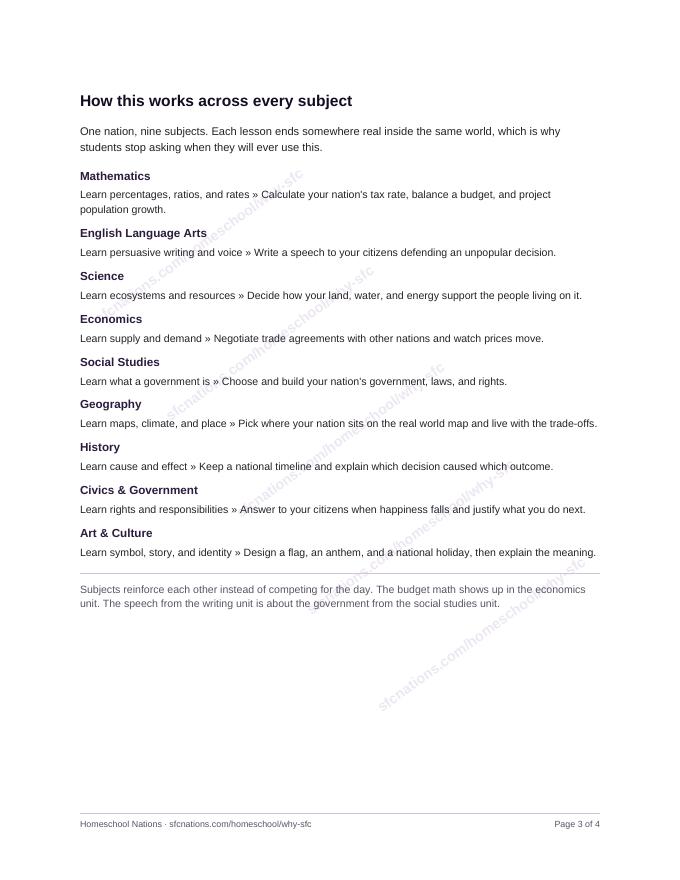
One nation, every subject
Each lesson lands somewhere real inside the same world, which is why students stop asking when they will ever use this.
Mathematics
Learn percentages, ratios, and ratesCalculate your nation's tax rate, balance a budget, and project population growth.
English Language Arts
Learn persuasive writing and voiceWrite a speech to your citizens defending an unpopular decision.
Science
Learn ecosystems and resourcesDetermine how your nation's environment supports the people living in it.
Economics & Financial Literacy
Learn supply and demandManage trade between nations and watch prices move against you.
Social Studies
Learn what a government isCreate your nation's government, laws, and rights.
Geography
Learn maps, climate, and placePick where your nation sits on the real world map and live with the trade-offs.
History
Learn cause and effectKeep a national timeline and explain which decision caused which outcome.
Civics & Government
Learn rights and responsibilitiesAnswer to your citizens when happiness falls, and justify what you do next.
Art & Culture
Learn symbol, story, and identityDesign a flag, an anthem, and a national holiday, then explain the meaning.
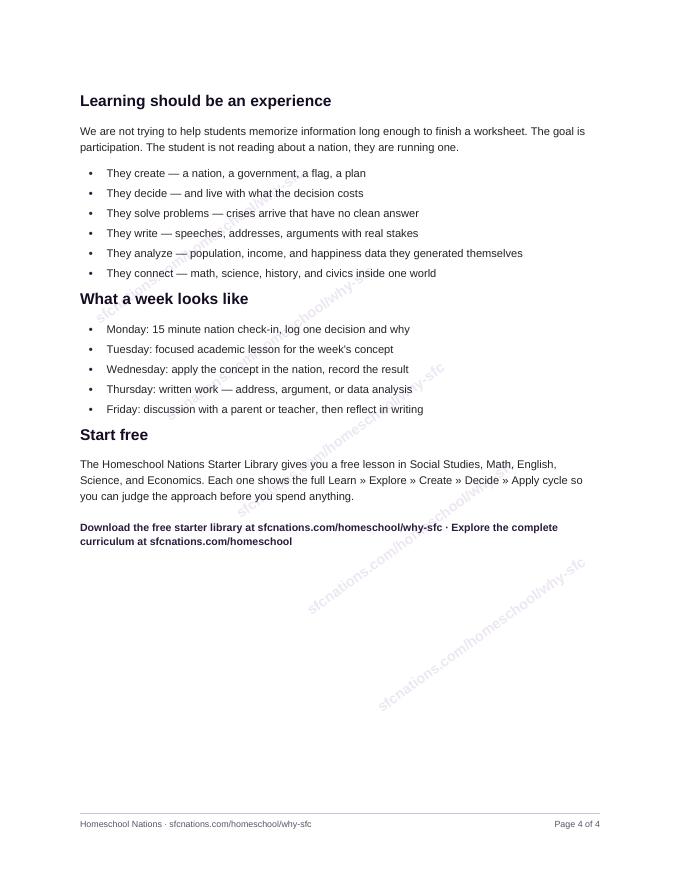
Learning should be an experience
We are not trying to help students memorize information long enough to finish a worksheet and move on. The goal is participation. The student is not reading about a nation, they are running one.
- They create — a nation, a government, a flag, a plan
- They decide — and live with what the decision costs
- They solve problems — crises arrive that have no clean answer
- They write — speeches, addresses, and arguments with real stakes
- They analyze — population, income, and happiness data they generated themselves
- They connect — math, science, history, and civics inside one world
FREE Homeschool Nations Starter Library
Five complete lessons, one per subject, each running the full Learn → Explore → Create → Make Decisions → Apply cycle with a student worksheet and parent notes. Free to download and print right now. No account, no email.
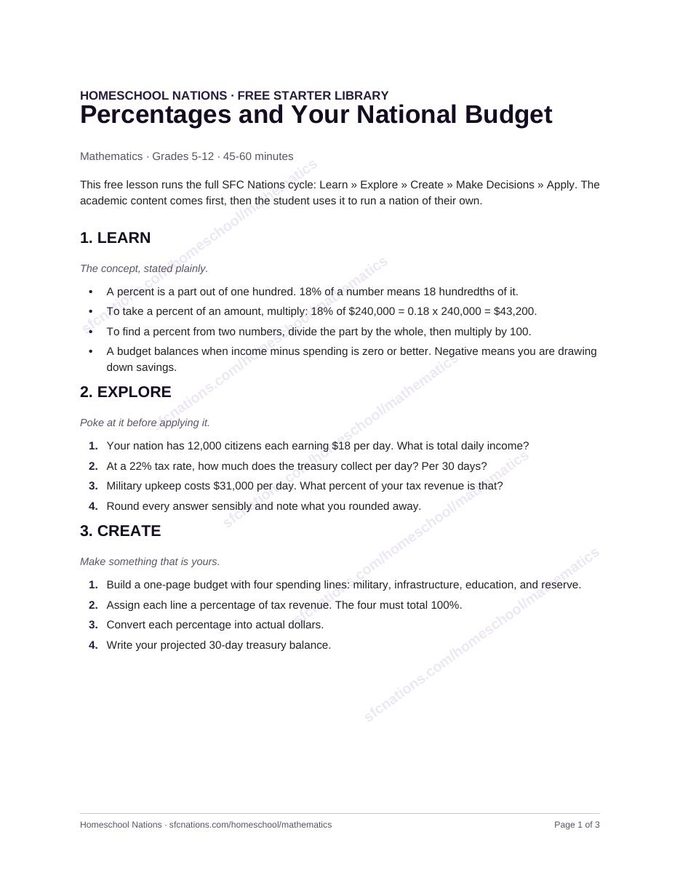
Percentages and Your National Budget
Grades 5-12 · 45-60 min · 3-page printable PDF
Percent of an amount, percent from two numbers, then a real four-line national budget the student has to balance and defend.
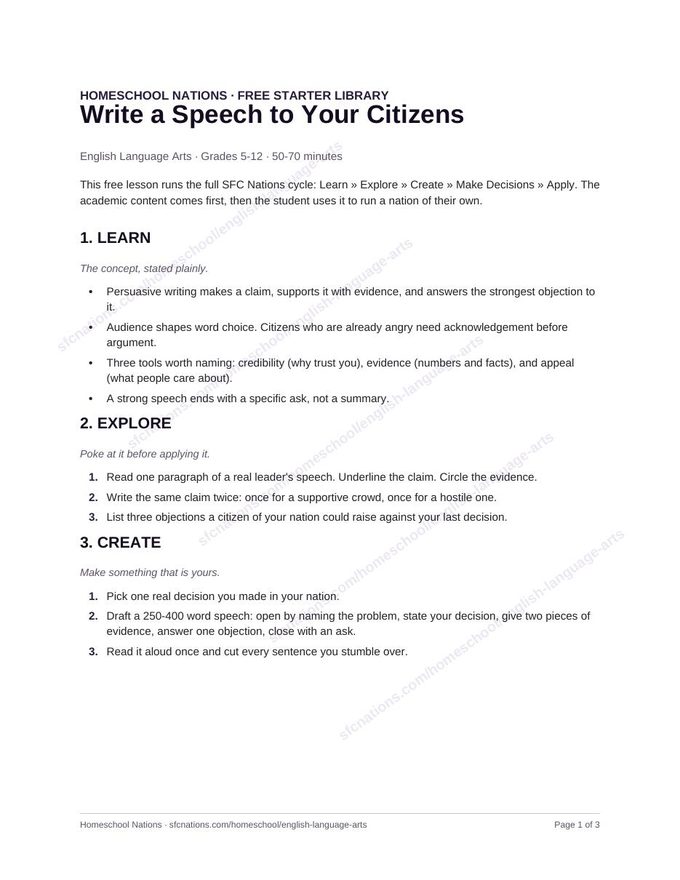
Write a Speech to Your Citizens
Grades 5-12 · 50-70 min · 3-page printable PDF
Claim, evidence, objection, ask. The student writes and delivers a 250-400 word address about a decision they actually made.
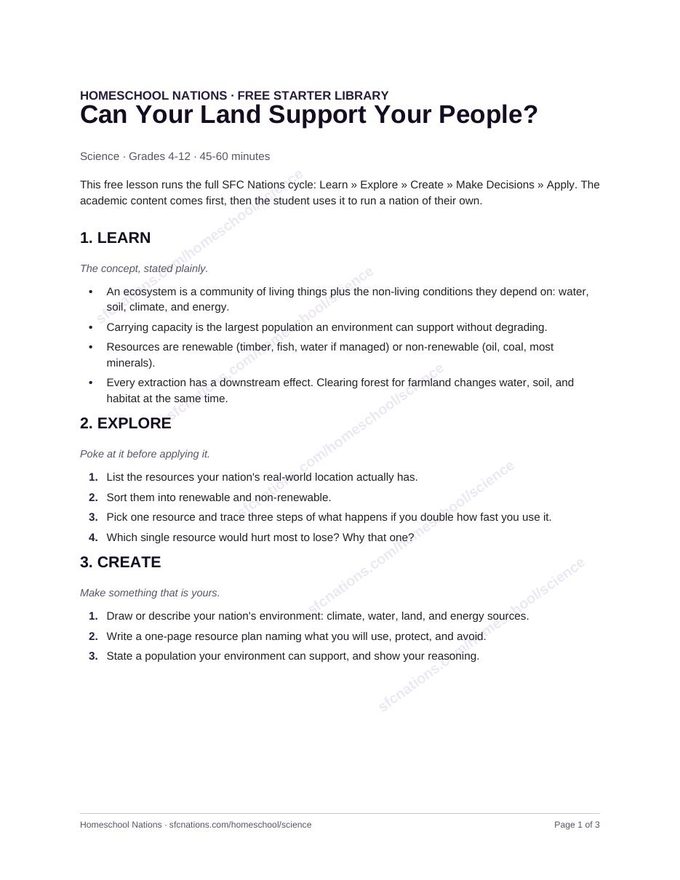
Can Your Land Support Your People?
Grades 4-12 · 45-60 min · 3-page printable PDF
Ecosystems, carrying capacity, and renewable versus non-renewable resources — applied to the land their nation is standing on.
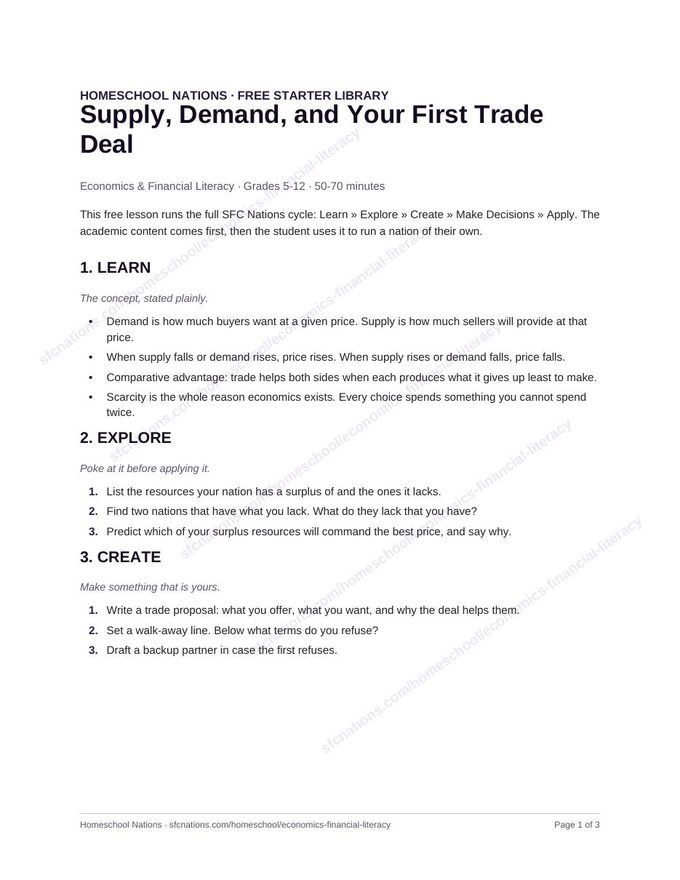
Supply, Demand, and Your First Trade Deal
Grades 5-12 · 50-70 min · 3-page printable PDF
Supply, demand, scarcity, and comparative advantage, then a live trade proposal with a walk-away line the student sets in advance.
Download: "Why Choose SFC Nations for Homeschool Curriculum?"
The full argument on 4 printable pages — something you can read later, hand to your spouse, or send to another homeschool parent or teacher who asks what this actually is.
Send this to another parent or teacher
Straight answers
Does SFC Nations replace our current curriculum?
No, and it is not trying to. It is the application layer. Keep the math book or the history text you trust; SFC Nations gives the student somewhere to use what that book taught them.
Is this just a game with worksheets attached?
The academic lesson comes first in every unit, and the worksheets ask for reasoning rather than recall. The nation is where the concept gets tested, not a reward for finishing the page.
What ages does this work for?
Roughly grades 4 through 12. Younger students need a parent beside them for the budget and trade math; high schoolers can run a nation and write the analysis on their own.
How much time does it take per week?
Most families spend 15 minutes a day inside the nation plus one longer lesson block. The weekly plan in every unit lays out a five-day rhythm you can shorten.
Are the free lessons really free?
Yes. The five starter lessons and every subject sample are free to download, print, and use today, with no account and no email required.
Can teachers use this in a classroom?
Yes. Students can run individual nations or share one as a class, and the decision questions are built for out-loud discussion and defense.
Ready to look at the subjects? Browse all nine Homeschool Nations units.
Build Your Government
Grades 4-12 · 45-60 min · 3-page printable PDF
Teach what a government actually is, then hand the student a nation and make them build one — leadership, laws, rights, and the bill for all of it.